The NBA released its 2026-27 regular-season schedule, and one team immediately jumped off the page.
The Philadelphia 76ers.
That alone would not necessarily be controversial. Philadelphia entered the offseason as one of basketball’s most fascinating teams. But then LeBron James chose Philadelphia, joining Joel Embiid and a loaded roster that suddenly became one of the NBA’s biggest attractions.
Now look at the schedule.
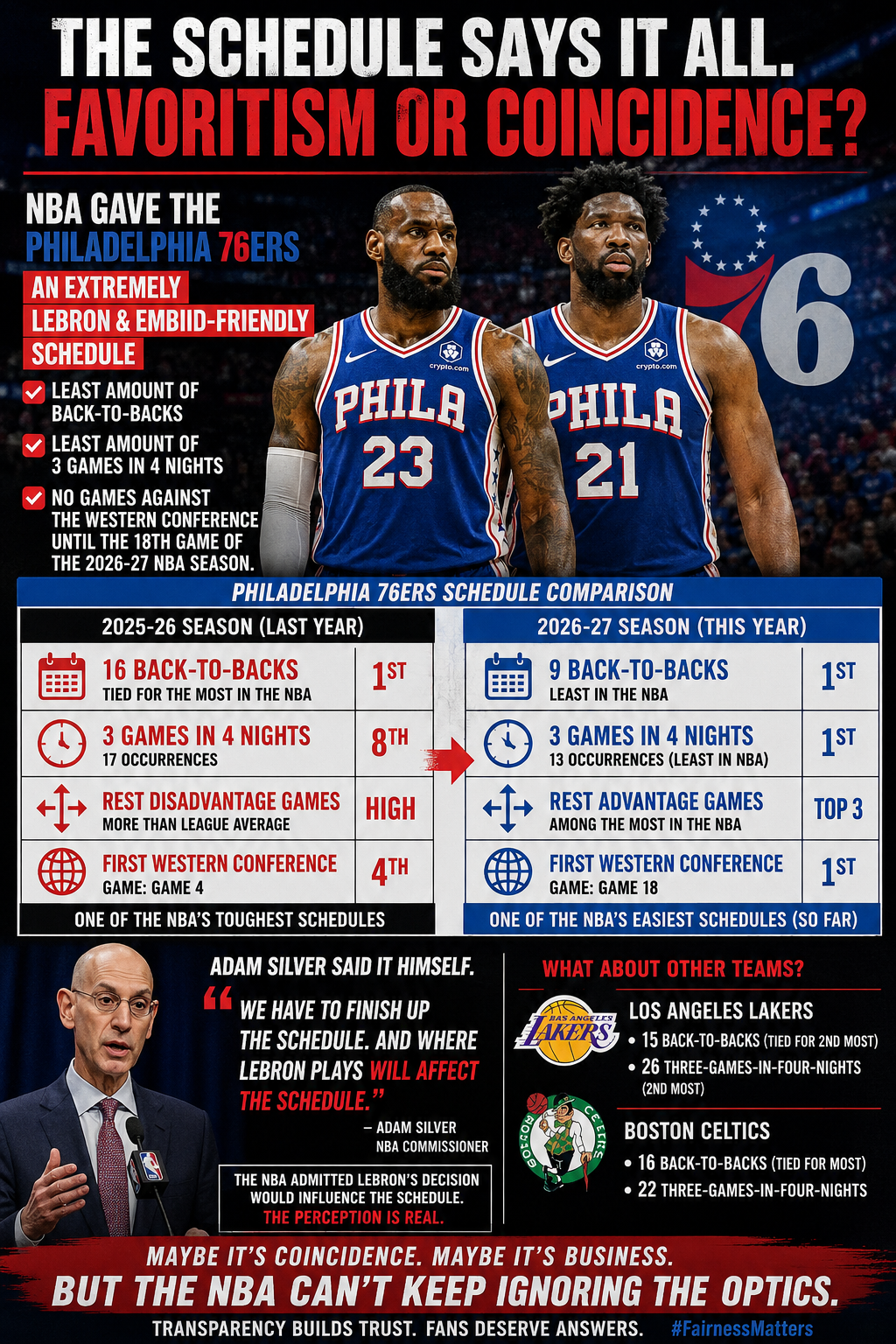
Philadelphia has one of the most favorable rest profiles in basketball. Reports and schedule analyses circulating since the release show the Sixers among the league’s leaders in avoiding back-to-backs and compressed stretches. Even more eye-opening, Philadelphia will not face a Western Conference opponent until its 18th game of the season. (Reddit)
Meanwhile, consider what happened last season.
Philadelphia entered 2025-26 with one of the NBA’s most demanding schedules. Contemporary schedule analysis had the Sixers at or near the top of the league with 16 back-to-back situations. The league-wide average was approximately 14.4. Philadelphia was grouped with Charlotte, Denver, Phoenix and Washington at the high end. (Hoops Rumors)
That is what makes the transformation worth discussing.
The Sixers went from one of the NBA’s most compressed schedules to one of its most favorable rest situations at precisely the moment LeBron James arrived.
Maybe that is coincidence.
Maybe it is the unavoidable result of arena availability, television demands, travel logistics, NBA Cup scheduling and thousands of other variables that go into constructing an 82-game schedule.
But the NBA itself created the perception problem.
Adam Silver Said the Quiet Part Out Loud
Before James announced where he would play, NBA Commissioner Adam Silver publicly acknowledged that the league was waiting for LeBron’s decision because it would affect the schedule.
Silver said:
“We have to finish up the schedule. And where LeBron plays will affect the schedule.”
Silver further explained that James’ destination would influence Opening Week, Christmas Day and other parts of the calendar because teams and television networks were waiting for the schedule to be finalized. (Los Angeles Times)
That admission matters.
To be fair to Silver, there is a completely legitimate business explanation.
LeBron James is arguably the biggest television attraction of his generation. Networks paying enormous sums for NBA rights obviously want to know where he is playing before marquee national broadcasts are selected.
That makes business sense.
But business logic does not eliminate questions about competitive fairness.
There is an enormous difference between saying, “We need to know where LeBron is playing so we can decide which games go on Christmas,” and creating a schedule that appears materially easier from a rest and travel standpoint after discovering which team he selected.
That distinction is where the NBA needs transparency.
Philadelphia’s Schedule Changed Dramatically
Last season provides the most important comparison.
Philadelphia’s 2025-26 schedule was difficult from a rest standpoint. The Sixers were scheduled for 16 back-to-backs according to league-wide analyses, tied for the most in the NBA. They nevertheless went 45-37, reached the playoffs and advanced through Boston before losing to New York. (Hoops Rumors)
There was an interesting counterweight. Philadelphia also received 14 games in which it held a rest advantage over its opponent, tied for the league high. That demonstrates why simply counting back-to-backs does not tell the entire story. (NBC Sports)
That context is important because criticism should be based on evidence, not conspiracy theories.
Now comes 2026-27.
Philadelphia has added James and Jaylen Brown to a roster already featuring Embiid, Tyrese Maxey and VJ Edgecombe. The NBA immediately placed Philadelphia against the defending champion New York Knicks on Opening Night and scheduled LeBron’s return to Los Angeles for Christmas Day. (Reuters)
Those decisions are understandable television programming.
The rest situation deserves more scrutiny.
Consider what other teams are dealing with.
Boston, Cleveland, Dallas and New Orleans are among teams facing 16 back-to-backs. Chicago has 15. The Lakers, interestingly enough now that LeBron is gone, have 15 back-to-backs and an enormous 26 three-games-in-four-nights stretches, the second-most difficult figure in the league according to an analysis of the newly released schedule. (SB Nation)
Read that again.
The Lakers lose LeBron and suddenly find themselves with 15 back-to-backs and 26 three-in-four situations.
LeBron joins Philadelphia and Philadelphia receives one of basketball’s friendliest rest profiles.
That does not prove favoritism.
It absolutely creates the appearance of it.
This Matters Even More Because of Joel Embiid
The schedule is not merely favorable to James.
It could be extremely valuable to Joel Embiid.
Embiid’s availability and workload have been central concerns surrounding Philadelphia for years. Back-to-backs matter enormously when an organization is trying to manage the workload of an aging or injury-prone superstar.
James will be 42 during the 2026-27 season.
Embiid has an extensive injury history.
Giving Philadelphia more recovery opportunities between games potentially allows the Sixers to manage both players more carefully while still pursuing a high playoff seed.
Again, that does not establish that the NBA intentionally designed the schedule to protect them.
But this is exactly why perception matters.
The NBA Cannot Have One Standard for Superstars and Another for Everyone Else
Professional sports leagues survive on the belief that competition is legitimate.
Nobody expects every NBA schedule to be identical. That is mathematically and logistically impossible.
Teams share arenas with NHL franchises. Concerts occupy buildings. Television partners want certain games. Travel must be considered. The NBA Cup complicates December. International games affect schedules. Geographic differences matter.
But there should be a transparent methodology explaining how competitive burdens are distributed.
Because when one franchise receives significantly more rest while another gets hammered with compressed stretches, fans have every right to ask why.
And when the commissioner publicly acknowledges that the league was waiting for one player’s free-agency decision before finishing the schedule, those questions become even more reasonable.
Is This Nepotism?
“Nepotism” may not be the technically precise word because LeBron James is not Adam Silver’s relative.
But the broader criticism behind that word is understandable: preferential treatment based on relationships, influence, commercial importance or status.
That perception has followed the NBA for years.
Superstars receive enormous influence.
Television markets matter.
Christmas games matter.
National television exposure matters.
Ratings matter.
Revenue matters.
And LeBron James has generated enormous amounts of all of them for more than two decades.
Nobody should pretend otherwise.
The problem begins when commercial considerations appear capable of influencing competitive conditions.
The NBA should want to eliminate that perception immediately.
There Is Also Another Side to This Argument
Fairness requires acknowledging something else.
Philadelphia arguably earned some scheduling relief.
The Sixers were at the high end of back-to-backs last season. If the league attempts to balance scheduling burdens across multiple seasons, Philadelphia moving from one extreme toward the other could have a legitimate explanation.
And delaying Western Conference games does not eliminate them.
Philadelphia still has to play those teams.
A Western-heavy portion of the schedule later could become considerably more difficult, particularly if it involves lengthy road trips during the playoff race.
That is why declaring the schedule “rigged” goes further than the available evidence supports.
Questioning it, however, is entirely legitimate.
The NBA Should Release More Scheduling Data
Instead of asking fans simply to trust the process, the NBA should publish a comprehensive scheduling fairness report every year.
Show every team’s:
- back-to-backs
- three-games-in-four-nights stretches
- four-games-in-six-nights stretches
- total travel mileage
- time-zone changes
- rest-advantage games
- rest-disadvantage games
- opponent rest differentials
- longest road trips
- longest homestands
- national television requirements
- arena conflicts
Then explain why major disparities exist.
Transparency would protect the NBA far more effectively than dismissing questions as conspiracy theories.
LeBron Is Not the Problem
This should not become another excuse to attack LeBron James.
He did not create the schedule.
He has earned his stature through more than two decades of extraordinary basketball.
The issue is institutional.
Adam Silver and the NBA acknowledged that James’ decision affected the scheduling process. Once the commissioner makes that statement publicly, scrutiny is inevitable.
The league cannot say LeBron’s destination matters enough to delay finalizing the schedule and then act surprised when people examine whether the team he chose received favorable scheduling conditions.
The Numbers Create the Perception
Philadelphia had one of the NBA’s heaviest back-to-back burdens last season.
LeBron arrives.
Philadelphia suddenly gets considerably more breathing room.
The Lakers lose LeBron and receive 15 back-to-backs and 26 three-games-in-four-nights situations. (SB Nation)
Philadelphia does not even see a Western Conference opponent until Game 18. (Reddit)
And before any of this happened, the commissioner publicly said the NBA needed LeBron to choose his next team because his destination would influence the schedule. (Los Angeles Times)
None of that proves corruption.
None of it proves the NBA deliberately manipulated the schedule to help Philadelphia win a championship.
But sports leagues should understand something important:
The appearance of favoritism can damage credibility even when favoritism cannot be proven.
The NBA has spent years promoting competitive balance while simultaneously building an entertainment business increasingly dependent on superstar personalities, television partners, gambling-related scrutiny and massive media-rights contracts.
That makes transparency more important, not less.
Maybe Philadelphia simply got lucky.
Maybe last year’s brutal schedule warranted some relief.
Maybe arena availability explains much of it.
Maybe the schedule will look significantly harder by February and March.
Those possibilities deserve consideration.
But so does the obvious question:
If LeBron James had signed somewhere else, would Philadelphia have received this exact same schedule?
After Adam Silver’s own comments, that is no longer an unreasonable question.
It is one the NBA created for itself.